Website edition | May 31, 2026
StinkDEX Health white paper
StinkDEX Health helps people understand what changing environmental conditions mean for daily plans and personal check-ins. The app combines the Pattern Engine, Today, Planner, Map, Explore, Premium follow-through, optional location, and careful trust boundaries.
1. Executive summary
Environmental context people can actually use and compare with how they feel.
Environmental information is scattered across forecasts, air-quality dashboards, advisories, water notices, nearby-source records, and local reporting. StinkDEX Health turns that mix into practical context, then lets private check-ins help reveal correlation clues over time.
Pattern Engine
Daily check-ins pair with environmental snapshots so weekly insights can surface cautious correlation clues.
Today beyond AQI
A local status, the main drivers, and plain-language meaning that goes beyond a single air-quality number.
Timing windows
Projected better and worse windows help people choose when to be outdoors, wait, or check again.
Map awareness
Modeled emissions sources, Climate TRACE context, facility records, and smoke notes make nearby source context easier to inspect.
Explore and Reader Briefs
Quick reads connect current events, industry, policy, disasters, and official actions to daily environmental awareness.
Water
Provider lookup, public-data summaries, official links, and hydration context sit beside the daily environmental read.
Premium follow-through
Day 3 planning, weekly Pattern Engine review, Watchlist, alert tuning, themes, optional BYOK Labs article analysis, and two access paths: paid Premium or eligible $StinkDEX holder verification.
Privacy-aware access
The core app does not need an account. Location, Labs, backups, diagnostics, paid Premium, and $StinkDEX holder verification are separate choices.
How the app helps

2. The problem
People have data, but not always clarity.
A person trying to plan a normal day may need to check weather, AQI, pollen, wildfire smoke, water notices, public advisories, and local news. Even when each source is useful, the burden of connecting them still falls on the user.
- Important signals are split across many tools, each with its own vocabulary and update rhythm.
- Raw metrics can show what changed without explaining what the change may mean for routine timing or health check-ins.
- Headlines can be relevant but noisy, broad, or hard to prioritize quickly.
- People experience conditions differently, yet most tools stop at a generic forecast or single index.
- Nearby industrial, facility, fire, smoke, and modeled-source context is often invisible unless a user already knows where to look.
- Official instructions matter most, but they are not always easy to connect to the rest of the day.
3. Product vision
A calm decision layer for environmental awareness and personal pattern learning.
The goal is not to replace weather apps, AQI trackers, official advisories, news sources, or medical care. The goal is to help people understand what environmental signals may mean together, then compare them carefully with check-ins they choose to save.
Readable first
Use short explanations, clear source cues, and practical context before asking users to inspect raw data.
Useful with limits
Offer planning support without claiming medical, emergency, safety, financial, or guaranteed outcomes.
Personal without overclaiming
Use user-controlled sensitivity, check-ins, and local history as correlation context rather than diagnosis or proof.
Official sources stay in view
Keep public-health, utility, weather, and emergency sources visible when they are relevant.
4. Product overview
The app is built as connected surfaces, not one crowded dashboard.
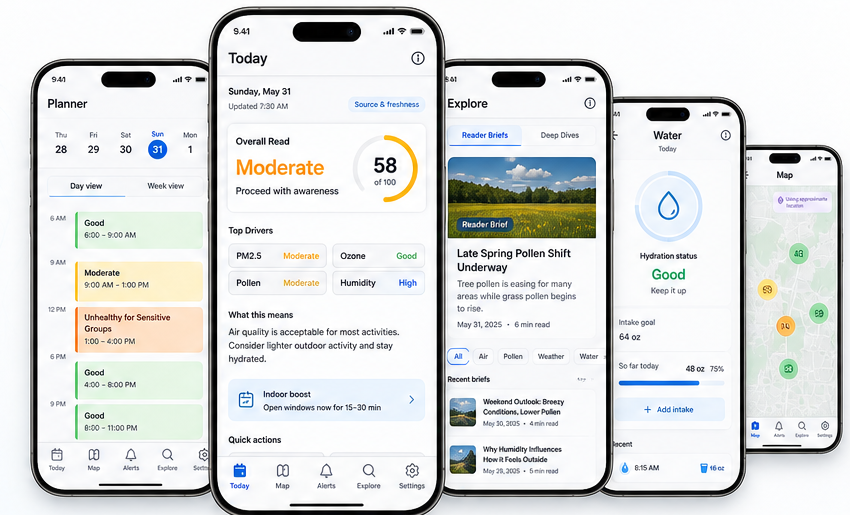
Each surface answers a different user question: what is happening now, when is a better outdoor window, what source context is nearby, what story matters, what did my check-ins show, and what should I revisit later?
Pattern Engine
Daily check-ins and local environmental snapshots that can support weekly pattern review when enough history exists.
Today
Daily environmental read, main drivers, practical meaning, and links to supporting detail beyond raw AQI.
Planner
Projected easier and rougher windows for today and tomorrow in the free core, with Day 3 through Premium.
Map
Nearby modeled emissions, Climate TRACE context, facility records, smoke notes, and source-list fallback context.
Explore
Canonical feed, Reader Briefs, source links, quick reads, saved articles, and current-event context.
Follow-through
Weekly patterns, Watchlist return paths, investigation preferences, alert tuning, themes, optional BYOK Labs article help, and Premium access through payment or eligible $StinkDEX holdings.
5. Today / Daily Read
Start with what today means.
The Today surface is the front door: a plain-language read that explains current conditions, the most relevant drivers, and what deserves attention without reducing the day to one AQI number.
- Summarizes the day in a concise status instead of a wall of unrelated measurements.
- Highlights likely drivers such as PM, ozone, pollen, humidity, heat, UV, fire and smoke context, or relevant water context.
- Uses freshness and confidence cues so the user can tell when a read is strong, partial, or worth rechecking.
- Works with broad context when location is off, and becomes more local when the user chooses a location or saved area.
- Keeps official guidance and source context more important than app interpretation when they conflict.
6. Planner timing windows
Timing is often the practical decision.
Many environmental choices are not simply yes or no. The Planner shows how conditions are projected to change so a user can choose when it is better to be outdoors, when to wait, and when to recheck.
Free planning
Today and tomorrow timing support are part of the free core, so a user can make near-term routine choices without upgrading.
Premium extension
Day 3 planning adds a longer look when tomorrow is not enough for errands, outdoor plans, travel, or follow-through.
Tradeoffs, not commands
Windows help compare timing. They do not guarantee safety, exposure, health outcomes, or perfect local conditions.
Readable labels
Easier window, lower-risk window, rougher stretch, and use-care language keeps the Planner understandable without hiding uncertainty.
7. Reader Briefs and Explore
Understand relevant stories without extra setup.
Explore is not a generic news feed. It is a reading surface for environmental stories that may affect daily awareness, including current events, industry, policy, disasters, official actions, and source links.
- The canonical feed gives the app a durable low-cost reading path before optional providers are involved.
- Reader Briefs summarize what a story is about, why it may matter, and where the original source can be opened.
- Decision shortcuts can move from a story to Planner, Saved Articles, Watchlist, or source review depending on intent.
- Saved articles keep useful stories, Reader Briefs, quick reads, and source links together on the device.
- Labs Assistant can help analyze an article, but it is not required for the core reading experience.
8. Water context
Provider context belongs beside the daily read.
Water is a practical part of environmental awareness. StinkDEX Health helps users search for or confirm a provider, review public-data summaries, and open official links when water context matters.
- Provider-specific context is kept distinct from broad nearby context so users understand what is confirmed and what is general.
- Official utility or state links are treated as the place to confirm active notices and binding instructions.
- Water context can sit alongside air, weather, pollen, smoke, and hydration reminders instead of living in a separate mental checklist.
- Labs advisory help is optional. Core advisory summaries and source links remain useful without Labs.
9. Map and alerts
Nearby context should stay useful and understandable.
The Map helps users reclaim context about pollution sources and facility records near places they care about. A full native map can make that easier to inspect; source lists still keep context useful when map tiles are unavailable.
- Map context is for orientation and source discovery, not proof of live exposure at an exact location.
- Modeled emissions context can include leading open-source Climate TRACE data, presented as context rather than real-time exposure.
- Facility context, smoke and wildfire notes, and source-list fallback help users compare what may be nearby.
- Core alerts can help surface changes, but notifications can be delayed or suppressed by the operating system.
- Official emergency, public-health, weather, and utility channels should remain the source for urgent or binding alerts.
- Location can improve nearby context, but the product still needs useful broad context when location is off.
10. Pattern Engine, check-ins, and sensitivity
Personalization should make context more relevant, not more absolute.
StinkDEX Health can use preferences, check-ins, saved areas, and local history to make guidance feel more relevant. The Pattern Engine pairs check-ins with environmental snapshots so weekly insights can surface repeated associations without implying diagnosis, treatment, causation, or guaranteed outcomes.
Sensitivity settings
Help shape interpretation and alerts without claiming clinical precision.
Environmental snapshots
Can include air signals, smoke/fire context, pollen, heat, UV, weather, water, nearby context, and freshness cues.
Check-ins
Can include symptoms, triggers, rough days, and no-symptom days that make pattern comparisons more honest.
Correlation only
Pattern findings are clues from local history. They are not medical advice, cause proof, or safety guarantees.
11. Trust, sources, and freshness
The app should show why it is saying something.
Trust depends on visible source context, freshness cues, careful language, and a clear distinction between public data, user-controlled context, and app interpretation.
- Source links should stay reachable from briefings, stories, water context, and supporting detail.
- Freshness cues matter because environmental data can lag, fail, or differ from conditions at a specific spot.
- Confidence-aware language is preferable to alarmist claims or false precision.
- When official guidance conflicts with app interpretation, official guidance should win.
12. Privacy and local-first design
Optional features should not redefine the core app.
The main experience does not require an account. Privacy messaging should clearly separate what stays on the device from what can leave for outside data providers, cloud Labs, store systems, wallet checks, backups, diagnostics, and third-party links.
- Location is optional and can improve nearby context when the user chooses it.
- Reader Briefs, saved articles, and daily guidance work without Labs.
- Cloud Labs is opt-in and can receive only a cloud-safe news or article package after the user sets it up.
- Paid Premium and $StinkDEX holder verification stay separate from symptom history and health logs.
- Backups and diagnostics are user-controlled and should be treated as potentially sensitive exports.
- The product should not sell personal data or ask for private keys or secret recovery phrases.
13. Premium and optional Labs
The free core should be useful before setup.
Premium is for follow-through when a longer planning view, recurring Pattern Engine review, Watchlist, tuning, themes, holder access, or optional BYOK Labs article help changes a concrete next step.
- Free includes: the canonical StinkDEX feed, Reader Briefs, source links, core alerts, today and tomorrow planning, saved articles, and daily data-based guidance.
- Premium adds: Day 3 planning, weekly Pattern Engine review, Watchlist return paths, alert quiet hours and sensitivity, investigation preferences, themes, and optional Labs Assistant article analysis.
- Why it shines: Premium is strongest when a user wants StinkDEX Health to become a planning, investigation, and review habit rather than a once-a-day condition check.
- BYOK means Bring Your Own Key: Premium users can connect their own AI provider key so Labs can send selected news/article content, Reader Brief context, source links, policy updates, industrial events, or disaster coverage to high-powered AI for deeper article insight.
- News-only Labs boundary: BYOK Labs is for analyzing news/article material. It should not receive app location, coordinates, local-area labels, health check-ins, symptom logs, raw check-in notes, health-log free text, or Pattern Engine history.
- Access paths: Premium can be unlocked by paying for Premium or by verifying a wallet that holds the required amount of $StinkDEX tokens. Donations and Labs setup remain separate choices.
- Holder recognition: $StinkDEX holder access pays homage to the community that believed early by making eligible holders first-class Premium members, while avoiding financial, investment, yield, return, redemption, resale-value, or guaranteed-access claims.
14. Differentiation
More than a forecast, tracker, or feed.
StinkDEX Health sits between public environmental sources, personal check-ins, nearby-source context, and everyday decisions. Its role is interpretation with restraint.
More than a weather app
Weather apps describe forecast conditions. StinkDEX Health helps connect those conditions to practical environmental awareness.
More than an AQI tracker
AQI tools are useful for monitoring a metric. StinkDEX Health adds broader conditions, fire and smoke context, timing, nearby sources, check-ins, and follow-through.
More than a news feed
News apps optimize for volume. StinkDEX Health focuses on relevance, source visibility, and what a story may mean for the day.
More than a setup funnel
The free product should answer useful daily questions before Premium payment, holder verification, or Labs setup enter the picture.
More than a symptom log
Check-ins matter because they are paired with environmental history and no-symptom days, not because the app claims medical certainty.
15. Responsible use and limitations
Useful, but deliberately limited.
The app can reduce interpretation burden, but it cannot remove uncertainty or replace official sources.
- It is not medical advice, diagnosis, treatment, emergency guidance, or a guarantee of safety.
- Official public-health, utility, weather, and emergency instructions should override app interpretation when they conflict.
- Environmental data can be delayed, incomplete, model-based, unavailable, or wrong for an exact location.
- Notifications depend on the device operating system and should not replace official alert channels.
- Premium does not make same-day exposure, safety, emergency, medical, legal, or financial claims stronger.
16. Roadmap relationship
The roadmap should stay status-oriented.
This white paper explains the product thesis and trust model. The public roadmap should remain shorter and status-oriented: what is useful now, what is improving next, how Premium evolves, and what claims the product will not make.
Available core
Today, tomorrow, Reader Briefs, source links, saved articles, core alerts, water context, check-ins, and broad guidance with or without location.
Coming next
Clearer platform availability, walkthroughs, improved public explanations, and stronger source/freshness communication.
Premium follow-through
Longer planning, Pattern Engine reviews, Watchlist, tuning, investigation preferences, themes, optional BYOK Labs news analysis, and access through payment or eligible $StinkDEX holdings.
Trust commitments
No medical, emergency, safety, legal, financial, token-return, or guarantee claims. Official sources remain primary.
17. Public notice
A product description, not a promise of outcomes.
- This white paper describes the intended public product direction as of May 31, 2026. Interfaces, data sources, access paths, and roadmap items can evolve.
- Nothing here should be interpreted as medical advice, emergency guidance, legal advice, financial advice, investment advice, or a guarantee of safety or accuracy.
- Use official public-health, utility, weather, emergency, store, wallet, and third-party service information where those sources apply.